Indicate what happens to the concentration of Pb2 in each cell.
What is Nernst Equation?
The Nernst equation provides a relation between the jail cell potential of an electrochemical prison cell, the standard cell potential, temperature, and the reaction quotient. Even nether non-standard weather condition, the prison cell potentials of electrochemical cells can exist adamant with the help of the Nernst equation.
The Nernst equation is oftentimes used to calculate the cell potential of an electrochemical cell at any given temperature, pressure, and reactant concentration. The equation was introduced by a German language chemist named Walther Hermann Nernst.
JEE Principal 2021 Live Chemistry Paper Solutions 24-Feb Shift-1 Retentivity-Based

Table of Content
- Expression
- NERNST Equation at 250C
- Derivation
- Determining Equilibrium Constant
- Applications
- Limitations
- Solved Examples
Expression of Nernst Equation
Nernst equation is an equation relating the capacity of an atom/ion to have up one or more electrons (reduction potential) measured at any conditions to that measured at standard atmospheric condition (standard reduction potentials) of 298K and one molar or 1 atmospheric pressure.
Nernst Equation for Single Electrode Potential
Ejail cell = E0 – [RT/nF] ln Q
Where,
- Ecell = cell potential of the jail cell
- E0 = cell potential under standard conditions
- R = universal gas constant
- T = temperature
- n = number of electrons transferred in the redox reaction
- F = Faraday constant
- Q = reaction quotient
The calculation of unmarried electrode reduction potential (Due eastcherry) from the standard single electrode reduction potential (E°red) for an atom/ion is given by the Nernst equation.
⇒ Also Read: Redox Reactions
For a reduction reaction, Nernst equation for a single electrode reduction potential for a reduction reaction
Mn+ + ne – → nM is;
Ered = EMn+/M = EoMn+/M – [2.303RT/nF] log [ane/[Mn+]]
Where,
- R is the gas constant = 8.314 J/M Mole
- T = accented temperature,
- north = number of mole of electron involved,
- F = 96487 (≈96500) coulomb/mole = charged carried by one mole of electrons.
- [Thoun+] = active mass of the ions. For simplicity, information technology may be taken as equal to the tooth concentration of the table salt.
Nernst Equation at 25oC
For measurements carried out 298K, the Nernst equation can be expressed every bit follows.
Due east = E0 – 0.0592/n log10 Q
Therefore, as per the Nernst equation, the overall potential of an electrochemical prison cell is dependent on the reaction quotient.
Derivation of Nernst Equation
Consider a metal in contact with its ain common salt aqueous solution. Reactions of metal losing an electron to become an ion and the ion gaining electron to return to the diminutive land are equally viable and are in an equilibrium state.
Mnorthward+ + ne – → nM
In the reduction reaction, 'n' moles of an electron is taken up by the ion against a reduction potential of Escarlet.
i. The piece of work washed in the movement of electron
Wred = nFEred
Where,
- F is Faraday = 96487 coulomb = electrical charge carried by 1 mole of electrons
two. Change in the Gibbs free energy is an indication of the spontaneity and information technology is too equal to the maximum useful work (other than volume expansion) done in a procedure.
Combining piece of work done and Gibbs free energy change:
Wcrimson = nFEred = – ∆G or ∆G = – nFEcrimson
three. Alter in the free energy at standard conditions of 298K and one molar /ane atmospheric force per unit area atmospheric condition is ∆Thousand°. From the in a higher place relation, it tin be written that
∆Yard° = – nFE°blood-red
Where,
- E°red is the reduction potential measured at standard weather condition.
iv. During the reaction, concentration keeps irresolute and the potential also will decrease with the charge per unit of reaction.
To become the maximum piece of work or maximum complimentary energy modify, the concentrations have to exist maintained the same. This is possible only past carrying out the reaction under a reversible equilibrium condition.
For a reversible equilibrium reaction, vant Hoff isotherm says:
∆One thousand = ∆G° + RT ln K
Where,
- K is the equilibrium constant
- K = Product/Reactant = [M]n/[One thousand]n+
- R is the Gas constant =8 .314J/K mole
- T is the temperature in Kelvin scale.
5. Substituting for free energy changes in ant Hoff equation,
– nFEred = – nFE°cherry-red + RT ln [M]/[Mn+] = – nFE°cherry + two.303 RT log [M]n/[Mn+]
Dividing both sides by – nF,
Eruby-red = Eastward°red –
\(\brainstorm{array}{50}\frac{2.303 RT}{nF1}\log\frac{[G]^n}{[M^{n+}]}\stop{array} \)
or,
\(\begin{array}{50}EM^{north+}/Yard =East^o Chiliad^{northward+}/Chiliad -\frac{two.303 RT}{nF1}\log\frac{[One thousand]^north}{[M^{n+}]}\stop{array} \)
The activity of the metal is, ever considered as equal to unity.
Ecerise = Due east°red – or
\(\begin{array}{l}E M^{n+}/{M}\end{assortment} \)
=
\(\begin{array}{l}E^o K^{n+}/{M}\end{array} \)
-\(\begin{array}{l}\frac{2.303 RT}{nF}\log\frac{1}{[Mn^{n+}]}\terminate{array} \)
This relation connecting reduction potential measurable at conditions other than standard conditions to the standard electrode potential is the Nernst equation.
For reaction conducted at 298K but at unlike concentrations, Nernst Equation is;
\(\begin{array}{fifty}Eastward G^{n+}/{M}\terminate{array} \)
=\(\begin{assortment}{50}E^o M^{n+}/{K}\stop{array} \)
-\(\begin{array}{l}\frac{2.303\times 8.314 \times293}{n96500}\log\frac{1}{[Mn^{n+}]}\stop{assortment} \)
=
\(\begin{array}{l}E^o Yard^{north+}/{M}\cease{array} \)
-\(\begin{array}{l}\frac{0.0591}{n}\log\frac{1}{[Mn^{n+}]}\end{array} \)
Determining Equilibrium Abiding with Nernst Equation
When the reactants and the products of the electrochemical cell reach equilibrium, the value of ΔG becomes 0. At this point, the reaction quotient and the equilibrium constant (Kc) are the same. Since ΔG = -nFE, the prison cell potential at equilibrium is likewise 0.
Substituting the values of Q and E into the Nernst equation, the following equation is obtained.
0 = E0 cell – (RT/nF) ln Thousandc
The human relationship between the Nernst equation, the equilibrium abiding, and Gibbs energy change is illustrated below.
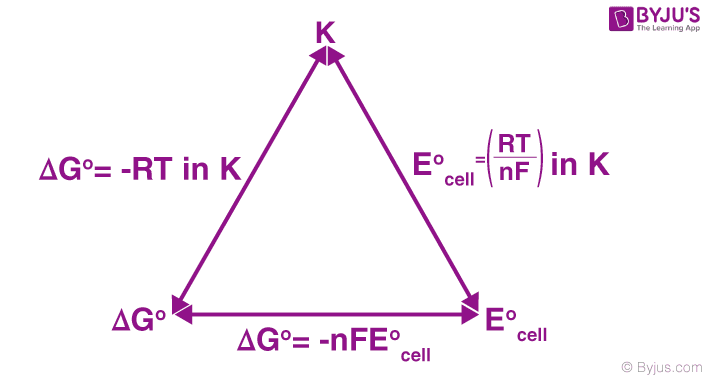
Nernst equation vs Equilibrium constant vs Gibbs free energy alter
Converting the natural logarithm into base of operations-10 logarithm and substituting T=298K (standard temperature), the equation is transformed as follows.
Eastward0 jail cell = (0.0592V/n) log Kc
Rearranging this equation, the following equation tin can be obtained.
log Kc = (nE0 jail cell)/0.0592V
Thus, the relationship between the standard jail cell potential and the equilibrium abiding is obtained. When Kc is greater than one, the value of Eastward0 cell will exist greater than 0, implying that the equilibrium favours the forward reaction. Similarly, when Kc is less than 1, East0 cell volition agree a negative value which suggests that the contrary reaction will exist favoured.
Nernst Equation Applications
The Nernst equation can be used to summate:
- Single electrode reduction or oxidation potential at any conditions
- Standard electrode potentials
- Comparison the relative ability every bit a reductive or oxidative amanuensis.
- Finding the feasibility of the combination of such unmarried electrodes to produce electric potential.
- Emf of an electrochemical cell
- Unknown ionic concentrations
- The pH of solutions and solubility of sparingly soluble salts tin exist measured with the assist of the Nernst equation.
Limitations of Nernst Equation
The activity of an ion in a very dilute solution is close to infinity and can, therefore, be expressed in terms of the ion concentration. However, for solutions having very high concentrations, the ion concentration is not equal to the ion activity. In order to utilise the Nernst equation in such cases, experimental measurements must be conducted to obtain the true activeness of the ion.
Another shortcoming of this equation is that it cannot exist used to mensurate prison cell potential when there is a current flowing through the electrode. This is considering the period of current affects the activity of the ions on the surface of the electrode. Besides, additional factors such as resistive loss and overpotential must be considered when there is a current flowing through the electrode.
Solved Examples on NERNST Equation
1. The standard electrode potential of zinc ions is 0.76V. What will exist the potential of a 2M solution at 300K?
Solution:
The Nernst equation for the given conditions can exist written every bit follows;
EMnorth+/Chiliad = Eo – [(2.303RT)/nF] × log i/[Mn+]
Hither,
- East° = 0.76V
- n = 2
- F = 96500 C/mole
- [Mn+] = ii M
- R =8.314 J/1000 mole
- T =300 M
Substituting the given values in Nernst equation we get,
EZn2+/Zn = 0.76 – [(two.303×8.314×300)/(2×96500)] × log 1/2 = 0.76 – [0.0298 × (-0.301)]
= 0.76 + 0.009 = 0.769V
Therefore, the potential of a 2M solution at 300K is 0.769V.
two. From the post-obit standard potentials, conform the metals in the lodge of their increasing reducing ability.
- Zn2+(aq) + 2e– → Zn(s): E° = -0.76 V
- Ca2+(aq) + 2e– → Ca(s): E° = -2.87 V
- Mg2+(aq) + 2e– → Mg(s): E° = -ii.36 Five
- Niii+(aq) + 2e– → Ni(s): E° = -0.25 5
- Ni(s) → Ni2+(aq) + 2e– : East° = +0.25 V
Reducing power of a metal increases with its ability to give upwards electrons ie lower standard potentials. Arranging the reduction potentials in the decreasing order gives the increasing order of reducing power of metals.
Increasing order of reduction potentials is Ni (-0.25V) < Zn (-0.76V) < Mg(-2.36V) < Ca(-2.87).
3. What is the Cell Potential of the electrochemical cell in which the jail cell reaction is: Pb2+ + Cd → Atomic number 82 + Cd2+ ; Given that Easto cell = 0.277 volts, temperature = 25oC, [Cdtwo+] = 0.02M, and [Pbii+] = 0.2M.
Solution
Since the temperature is equal to 25oC, the Nernst equation tin can be written as follows;
Ejail cell = Eastward0 cell – (0.0592/n) log10Q
Here, two moles of electrons are transferred in the reaction. Therefore, n = 2. The reaction quotient (Q) is given past [Cd2+]/[Pb2+] = (0.02M)/(0.2M) = 0.1.
The equation tin at present be rewritten as:
Due eastcell = 0.277 – (0.0592/2) × log10(0.1) = 0.277 – (0.0296)(-1) = 0.3066 Volts
Thus, the cell potential of this electrochemial cell at a temperature of 25oC is 0.3066 volts.
4. The Cu2+ ion concentration in a copper-argent electrochemical cell is 0.1M. If Eo(Ag+/Ag) = 0.8V, Eo(Cutwo+/Cu) = 0.34V, and Jail cell potential (at 25oC) = 0.422V, observe the argent ion concentration.
Solution
Hither, the silver electrode acts equally a cathode whereas the copper electrode serves as the anode. This is considering the standard electrode potential of the silver electrode is greater than that of the copper electrode. The standard electrode potential of the prison cell tin can now be calculated, as shown below.
Eo cell = Eo cathode – Eo anode = 0.8V – 0.34V = 0.46V
Since the charge on the copper ion is +2 and the charge on the silver ion is +1, the balanced cell reaction is:
2Ag+ + Cu → 2Ag + Cu2+
Since ii electrons are transferred in the prison cell reaction, northward = two. Now, the Nernst equation for this electrochemical jail cell can be written as follows.
Eprison cell = East0 jail cell – (0.0592/2) × log(0.i/[Ag+]2)
0.422V = 0.46 – 0.0296 × (-1 – 2log[Ag+])
Therefore, -2log[Ag+] = 1.283 + i = two.283
Or, log[Ag+] = -1.141
[Ag+] = antilog(-1.141) = 0.0722 GrandSource: https://byjus.com/jee/nernst-equation/
0 Response to "Indicate what happens to the concentration of Pb2 in each cell."
ارسال یک نظر